
The recently installed Zeiss LSM 980 is a high-end confocal laser scanning microscope optimized for spectral imaging, featuring a 32-channel spectral GaAsP detector and the Airyscan 2 area detector for sub-diffraction resolution (<120 nm XY) and high-sensitivity. Zeiss LSM 980 is ideal for imaging of fixed samples and for 4D (3D + time) live cell imaging. Technical characteristics:
- Inverted Axio Observer 7 SP stand for LSM 980 NLO with Definite Focus 3 nosepiece, with fully motorized functions. AI Sample Finder functionality for automated sample identification
- Automated Χ-Υ scanning stage (travel range: 130x100 mm) stage controller & joystick, frames for multiwell, petri & slides
- LED Colibri 7 light source (RGB-UV) with Dapi, GFP, Cy3, Cy5 filters
- environmental chamber (XLmulti) with controlled temperature, humidity and CO2 concentration
- apochromatic lenses of excellent quality:
- plan-apochromat 5x/0.16
- plan-apochromat 10x/0.30
- plan-apochromat 20x/0.8
- LD LCI Plan-Apochromat 40x/1.2 multi Immersion Corr DIC (FCS)
- Plan-Apochromat 63x/1.4 Oil DIC
- Laser Lines: 405nm, 445 nm, 488 nm, 514 nm, 561 nm, 639 nm
- Scan module LSM 980 Spectral detector 4 channels GaAsP PMT and 2 channels MA multi-alkali-PMT (6 channels in total).
- Airyscan 2 Patented super-resolution imaging device based on 32 arranged elements, including advanced fast and gentle imaging mode with 4x and 8x parallelization (Multiplex mode)
- Software ZEN 3.8 DLic
- camera Axiocam 705 color for color imaging modes
- High Performance Data Analysis and Storage Workstation
Applications:
- Confocal imaging that combines optical sectioning with low phototoxicity and high speed.
- Super-resolution imaging with Airyscan 2 detector
- Multiplex imaging with Airyscan detector for fast and gentle confocal super-resolution in samples with large volume
- Multiple image acquisition (tiles and position arrays)
- Live cell imaging
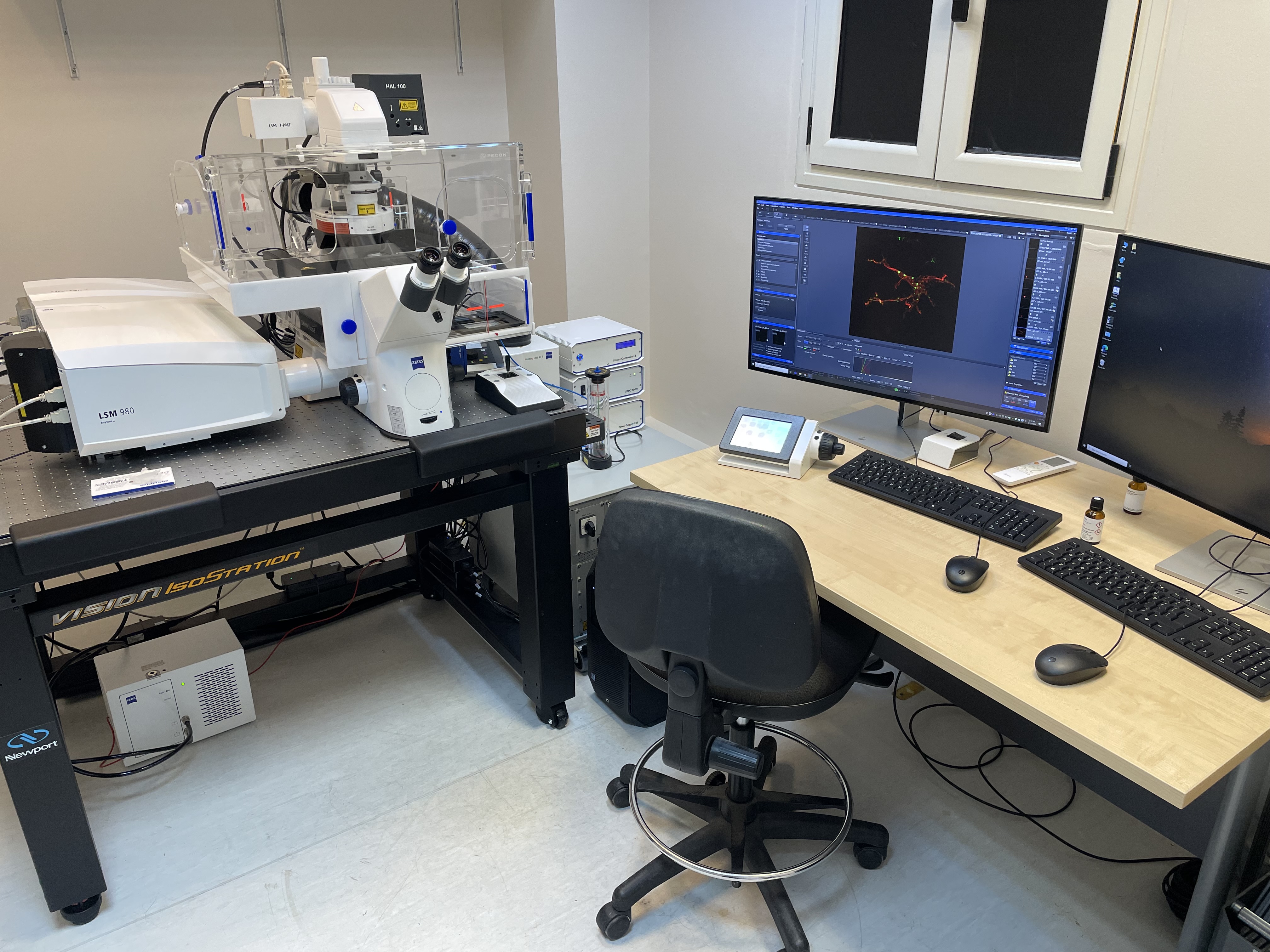
The Zeiss LSM 980 microscope has been acquired through National Recovery and Resilience Grant funding(MIS 5174647) and was installed in the HPI-BU in December 2025.